Norebangin in Mexico

The sizable Korean community in Mexico City’s Zona Rosa (among other places) wouldn’t be complete without norebangs. These are rooms you rent with a squad of karaoke revelers. The rooms come with mood lighting, multiple microphones, tambourines, rotating disco light, a large karaoke hard drive and a flat screen TV with a mega karaoke remote.

Speakers are studio sized and beer is available for about $40 pesos a pop, with a huge plate of fruit running around $250. Other side dishes at some norebangs in the area offer chicharron de pulpo, which is some kind of fried octapus treat, if you’re into that.

It’s easy to go norebang hopping, if you find yourself spending a weekend in Zona Rosa. I landed in one for a short spell (couldn’t get to my rendition of  “Livin on a Prayer”), London Karaoke, which was run by  a middle aged Korean man with a casual hunting-cap and bubble vest kind of style, named Park Hyo Yong. The price per hour for a norebang runs around $200 pesos, less than 20 bucks in U.S. cash.

For me, my karaoke thrills are best had at a venue with lots of strangers. I’m not into the tiny room thing, although it’s a great place to practice your stuff. Because  if you’ve had the odd experience of being caught up with a group of trilingual karaoke experts who bogard the mic and the karaoke controller, I feel your pain.
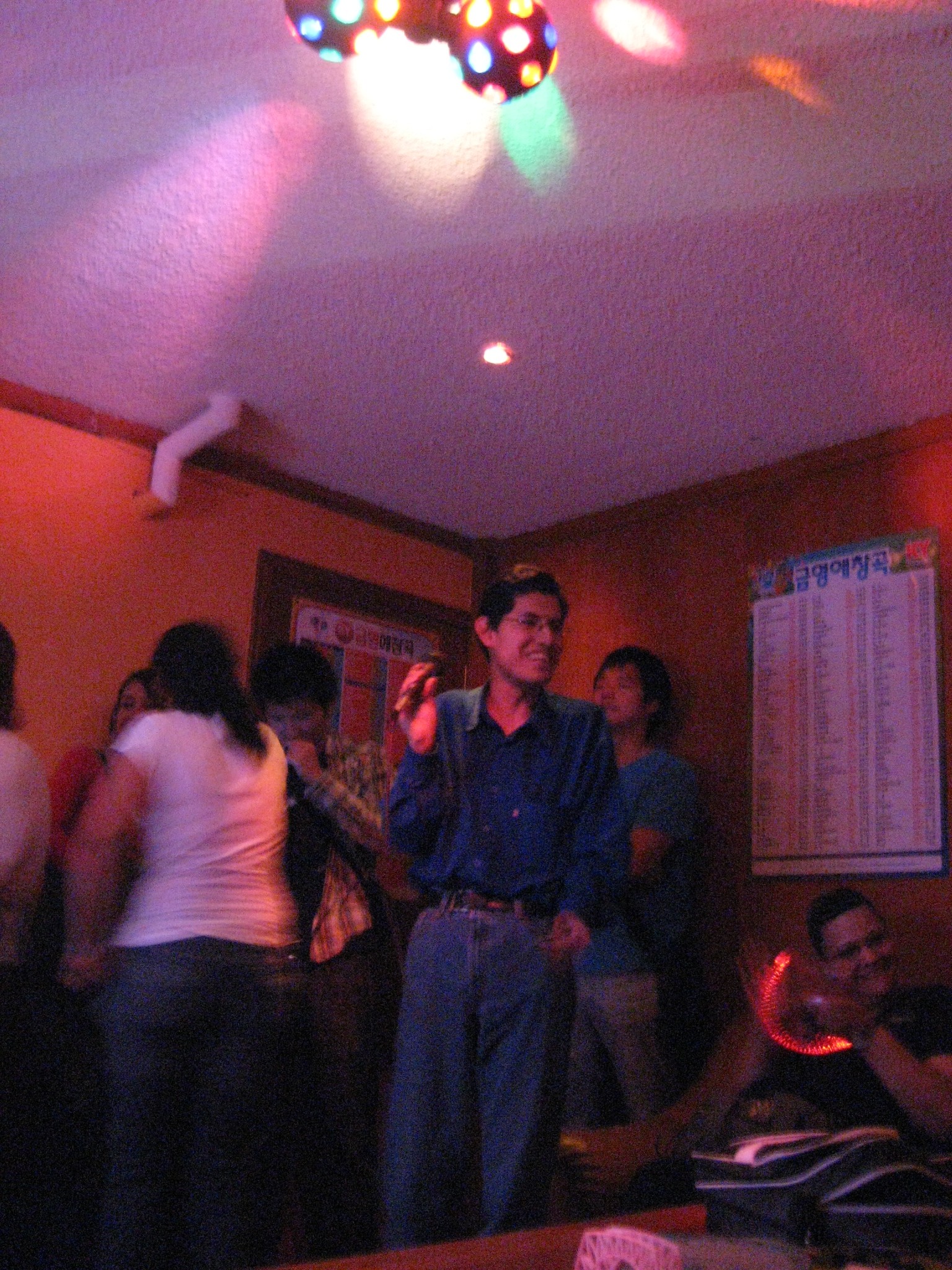
London Karaoke, Londres No. 167, 3 Piso, Esquina Florencia, Mexico, D.F., Telephone: 52-07-01-84


Post-race in the Americas II

POST-RACE IN MEXICO ::

My mission in these posts is not to say that Mexico is a bad place for Black folks. To the contrary, there’s a thriving population here from the Caribbean, Africa and Haiti, among other places.  The presence of these  cultures makes the city a much richer place to be.

But the fetishization of antiquated images of negritude, seems to flourish here. And it leads one to think that certain aspects of Mexican society are resisting progression towards a more inclusive country. Maybe that´s an exaggeration.

Still, that´s just my point of view. Which is obvious, given my background, growing up Black and Latino, code switching in a suburb of Newark, NJ.

And to be fair, those images are similar to these images, which we were nurtured on, while sitting in front of the T.V. in the U.S.  So, the representation of images of Africa and Africans here isn´t too different from our depiction of Native Americans at sporting events.

Above is a picture from Africam Safari (the “m” designating it as a Safari in (M)exico), in Puebla.

It´s been around since 1972.

Although that ¨African¨ mascot and other similarly disturbing (and hilarious) images dominate the park, it´s interesting that little of it is represented in park ads, or on the park´s Web site. Maybe because these images aren´t appropriate in 2010?

Photo gallery after the jump….

Continue reading “Post-race in the Americas II”

Google Video pick of the week #008

This week´s clip comes via one of the greatest comedic writers of his generation, Paul Mooney.  ¨Jesus Is Black¨ (2007), kicks off its first 10 minutes with ruminations on Mexicans and illegal immigration in California. Funny stuff.

Mooney might lean heavy on his use of the ¨N¨ word,  and makes harsh assessments of race in America his calling card. Still, you have to respect him, because he´s an uncompromised comedic force, who hasn´t been made soft by Disney movies and Hollywood contracts.

For the uninitiated, he may be hard to stomach. Sure, he´s racist, but there´s no denying some of the stinging truths in his work.

You can find  tons of video of Mooney´s work online. From his earlier days writing jokes for Richard Pryor, to clips of his hilarious creations on Dave Chappelle´s show.

Pryor  goes in on Paul around the 5:34 mark of this clip from a comedy roast.  Ending his session by calling Mooney a ¨brilliant writer¨.

¨Brilliant¨ doesn´t seem like an overstatement either, when you consider that Mooney is the man who created Homey D.  Clown.

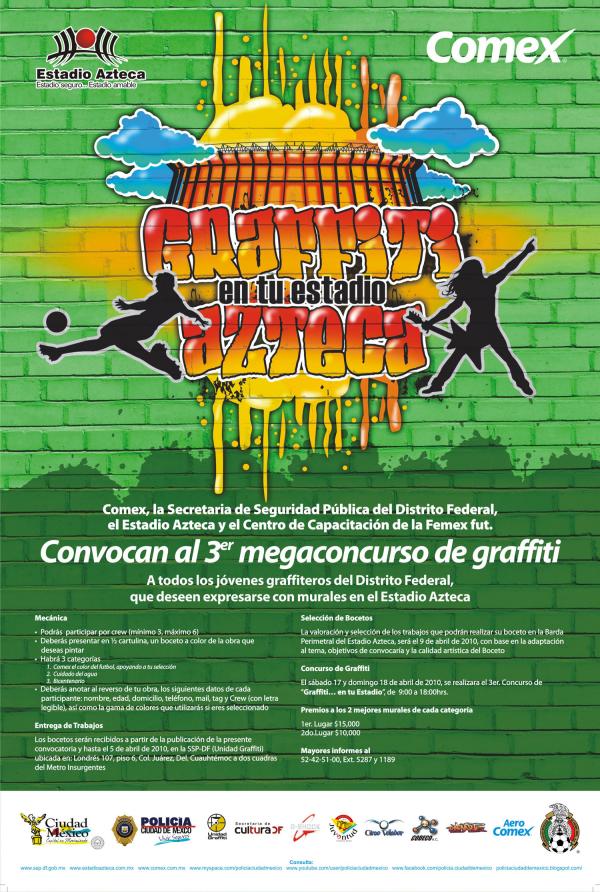
Essence of hip-hop en Estadio Azteca

In many parts of the modern world, graffiti is vilified. Here in Mexico, it´s a respected art form. Often encouraged.

From the renowned muralist culture, to even farther back to its ancient civilizations, communicating through art on walls has always been the way here.

Today, with the support of a paint company and local government agencies, what is essentially a free hip-hop festival will take over Mexico´s  main soccer stadium. A place were people go to worship futbol, for the 3rd year in a row, becomes a place for hip-hop´s faithful.

I went in 2009, and the event was regarded as too commercial by many graf heads. But, it´s one of the rare times in this megalopolis that lovers of rap music get a free open-air concert. ¨Wild Style¨ incarnate, here in Mexico City.

Below, Jezzy P , a rapper from Ecatepec who just dropped a new album     (she´s been putting years of work into her music) will be a featured rapper on Saturday afternoon. About two dozen rappers will perform over the weekend, while graf artists are competing on the walls of the stadium.

It´ll be like a day in the Bronx circa 1979.

Check out the list of scheduled rap performances on Jezzy´s blog.

In addition to Jezzy, highlights include performances by 2Phase,  Skool 77, Ana MC, Van T, T-Killa and Manicomio Clan, also check for ongoing cyphers in the parking lot.

The 3er. Concurso de Graffiti en tu Estadio Azteca 2010, co-sponsored by the Secretary of Public Security, takes place  April 17 and 18, from 10 a.m. to 4 p.m. at Mexico City´s Azteca Stadium.

Post-race in the Americas

In the week before Obama won his presidency, this guy on a Mexico City roof, above, thought up a great costume for a Day of the Dead party. There were only a handful of people who gave this get-up any pause.

There are a lot of complicated reasons, which I hope to explore throughout various blog posts, why many intelligent people in this country don’t see anything wrong with blackface, or deny racism exists here. As a person whose mother is from South America, and father from Prince Street in Newark, I’m always interested in how Black Latinos view themselves in the context of Spanish-speaking culture, and how those cultures in Mexico, Colombia, Brazil and Spain, view people who are Black.

This 2005 piece from the Boston Review, raises the race issue, starting with the Vicente Fox speech that said Mexicans grind doing the types of work not even Black folks want to do. That, along with the federal government nearly making a postal stamp with this character’s mug on it, brought international attention to Mexico’s apparent culture of racism (which really isn’t that different from what still exists in the U.S., we just hide it way better).

“Criticism of race relations and racism in Brazil, Mexico, the Andes, the Caribbean, and Central America has developed as a natural extension of multiculturalism and identity politics in the United States, and many studies describe persistent racial inequalities masked by the idea of racial democracy.

This criticism and research has, in turn, fed discussions of race in Latin America, albeit in an attenuated manner: Brazil has had its own proponents of “black power,” and racism against Indians has become a theme in Mexican social movements.

Because these challenges are difficult to reconcile with Mexico’s 80-year-old ideology of national integration, they are often downplayed in public debate—as if Mexican racism had long been taken care of, and as if whatever remains of it were somehow less harmful because things are worse in the United States.”

Check out more on the topic, here.

Continue reading “Post-race in the Americas”

¡ Ask a Jeweler !

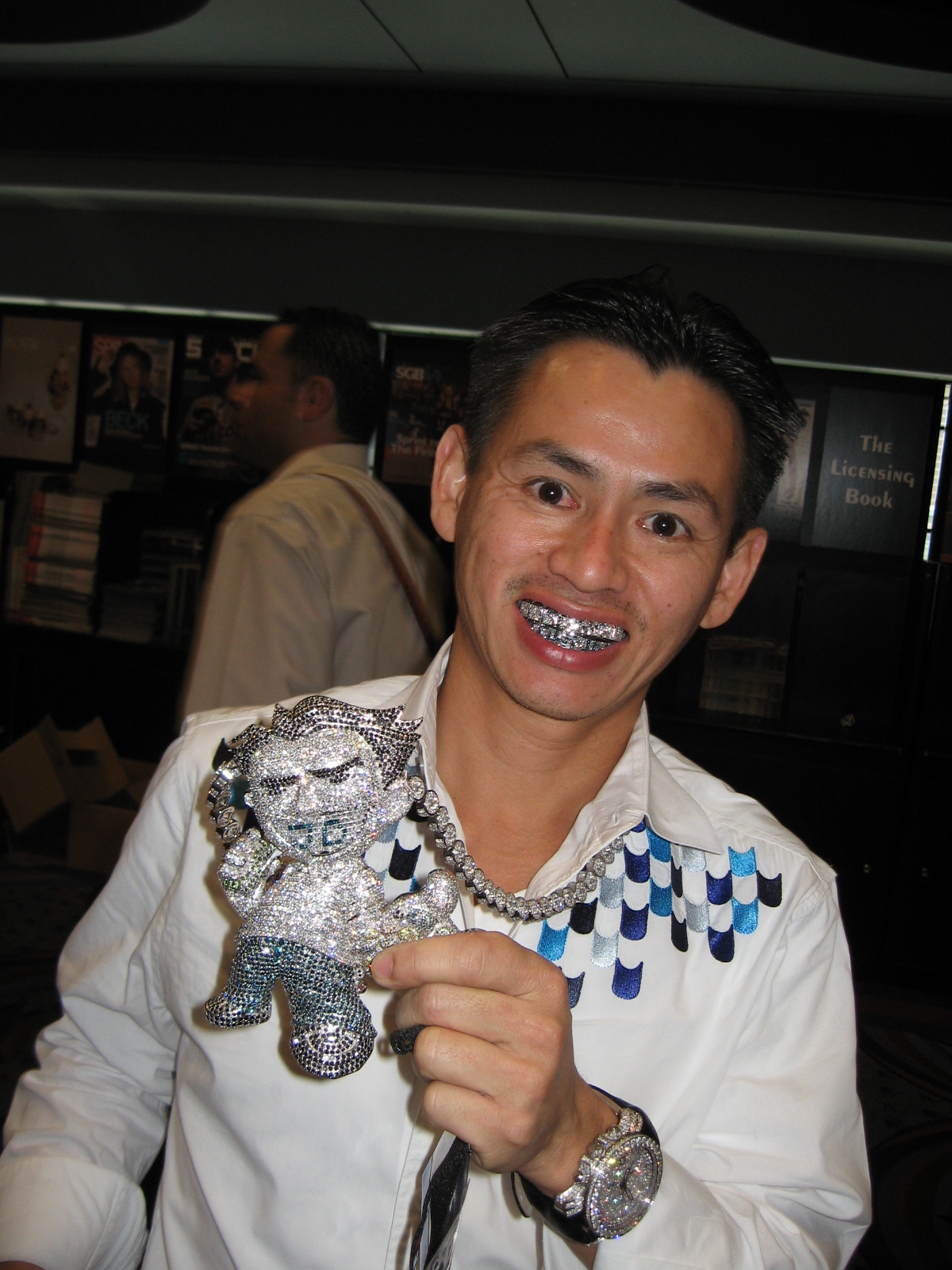
I’ve been clearing out photos from an old laptop and came across this 2008 snapshot. Many southern rap fans probably know TV Johnny Dang from his appearances in Slim Thug or Paul Wall videos. I talked to him for this piece I did back in ’07.

Looking at this photo again, though, TV reminds me a lot of an acquaintance, OC Weekly writer Gustavo Arellano. Not sure this qualifies as a “separated at birth” post. You decide.

Gustavo, as you can tell from his column and complete grip on  the OC immigration debate, is a Mexican journalist. TV Johnny is Vietnamese jeweler to southern rap stars. The thing they both share, other than having parents who were born in other countries, is being very successful in what they do.

Google Video pick of the week #006

——

La Señora Muerte (1967), is a couture horror flick. It was one of several pictures prolific B-movie director Jaime Salvador made with Luis Enrique Vergara at his Filmica Vergara CineComisiones production banner in Mexico.

This film opens with Marlene’s lover dying after sexing her. While being stricken, he asks for the shady Dr. Farell, an evil mad scientist-like character played by this guy’s dad.  Farell wickedly tells Marlene that he needs fresh blood to revive  her – much older – lover. Of course, to make things even more interesting, the blood has to come from young, fashion-forward women.

The film, while cheesy as hell (check out the mad scientists computer), features some fancy houses in what could be Polanco, and a wardrobe by Mexico’s foremost designer of the 60’s and 70s, Pedro Loredo. It works for the film since Marlene, an eventual killer and the woman of the flick’s title, is a fashion designer.

Her costuming— I presume is also by Loredo, in the credits his billing goes: “Desfile de modas/ diseños de Pedro Loredo/ creador de la moda mexicana.”

Continue reading “Google Video pick of the week #006”

A Night With El Pinche Brujo

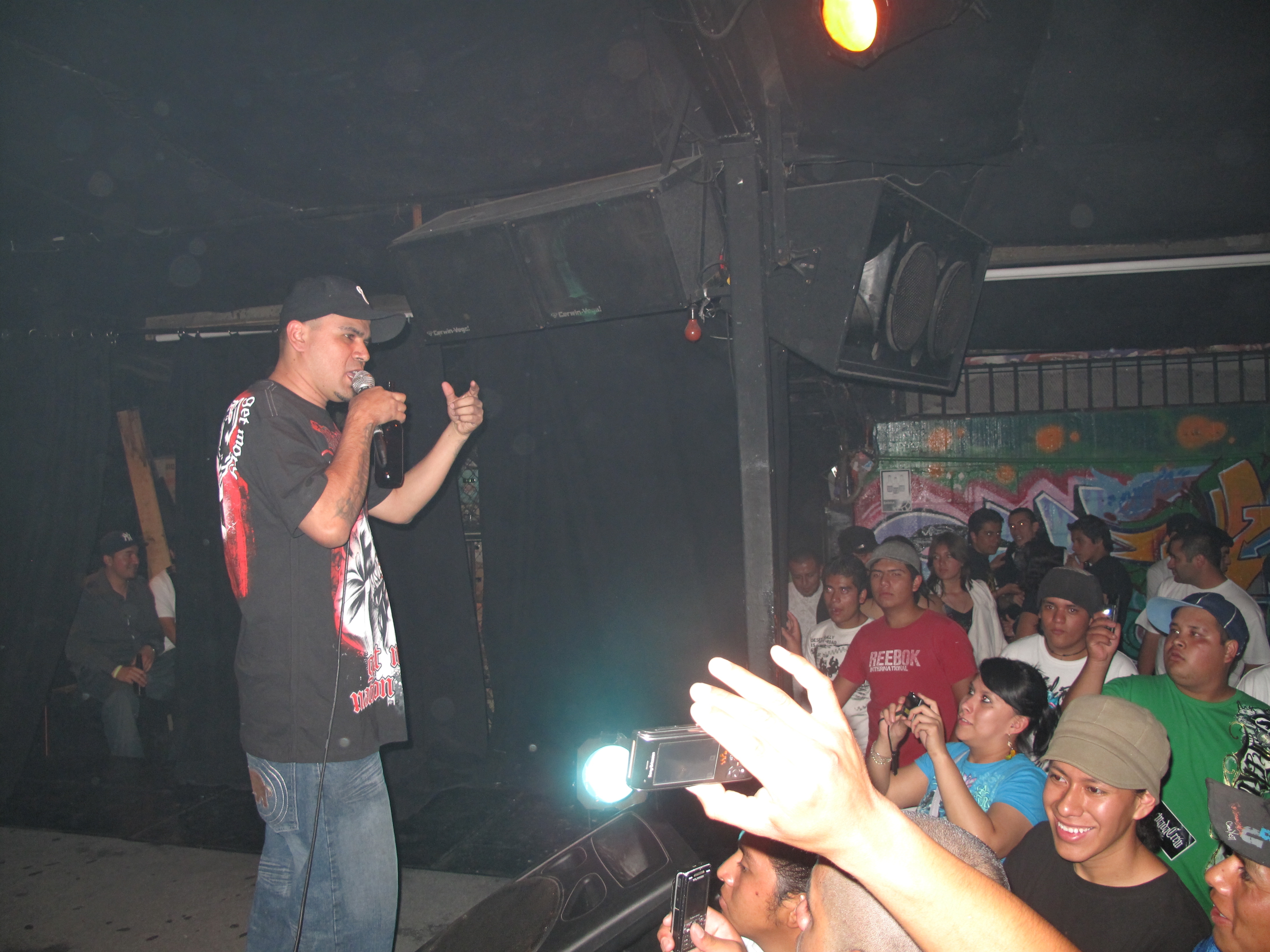
When I first heard El Pincho Brujo in his video for ¨Guadalajobru¨, an ode to his state´s top ranked soccer team and hip-hop lifestyle in Guadalajara, I thought I was hearing something special.

I didn´t realize regional Mexican rap had such a strong representative outside D.F. This guy, who came out of the Jalisco graffiti scene, hustles. ¨Brujo¨by the way, is the masculine for ¨witch,¨ and ¨pinche¨ as it´s used in most parts of Mexico, means either ¨damn¨, or  the adjectival ¨fucking¨.

On a Saturday night late last month Brujo showcased his skills. No DJ. Just him, a beer, and roomful of teenagers and curious hip-hop fans. He even took shout outs for rugged spots like Chalco and Iztapalapa.

He prowled the stage in mock drunkenness.  Hitting his rapped punch lines with a nasally flow ala B-Real, but with more bass in his voice. A few times he mentioned the drug cartel devastated Ciudad Juarez. But only got as deep as saying, ¨Man….Juarez.¨ Of course what more could he say?

On a sidenote: El Universal, earlier this year, did a good video report on hip-hop in Juarez. (via Red Barrio)

I´ve been told by one Monterrey performer that drug gangs are known to ¨tax¨ performers sometimes for their show money. It´s rare to hear the type of drug trade braggadocio here that litters U.S. rap.

Nedman Guerrero performed about an hour before Brujo´s midnite set.  One of Mexico City´s more practiced MCs, his style is strictly based in the old school New York-flavored street rap. Learn more about him in this interview (in Spanish) with the Grita Rap blog.

Continue reading “A Night With El Pinche Brujo”

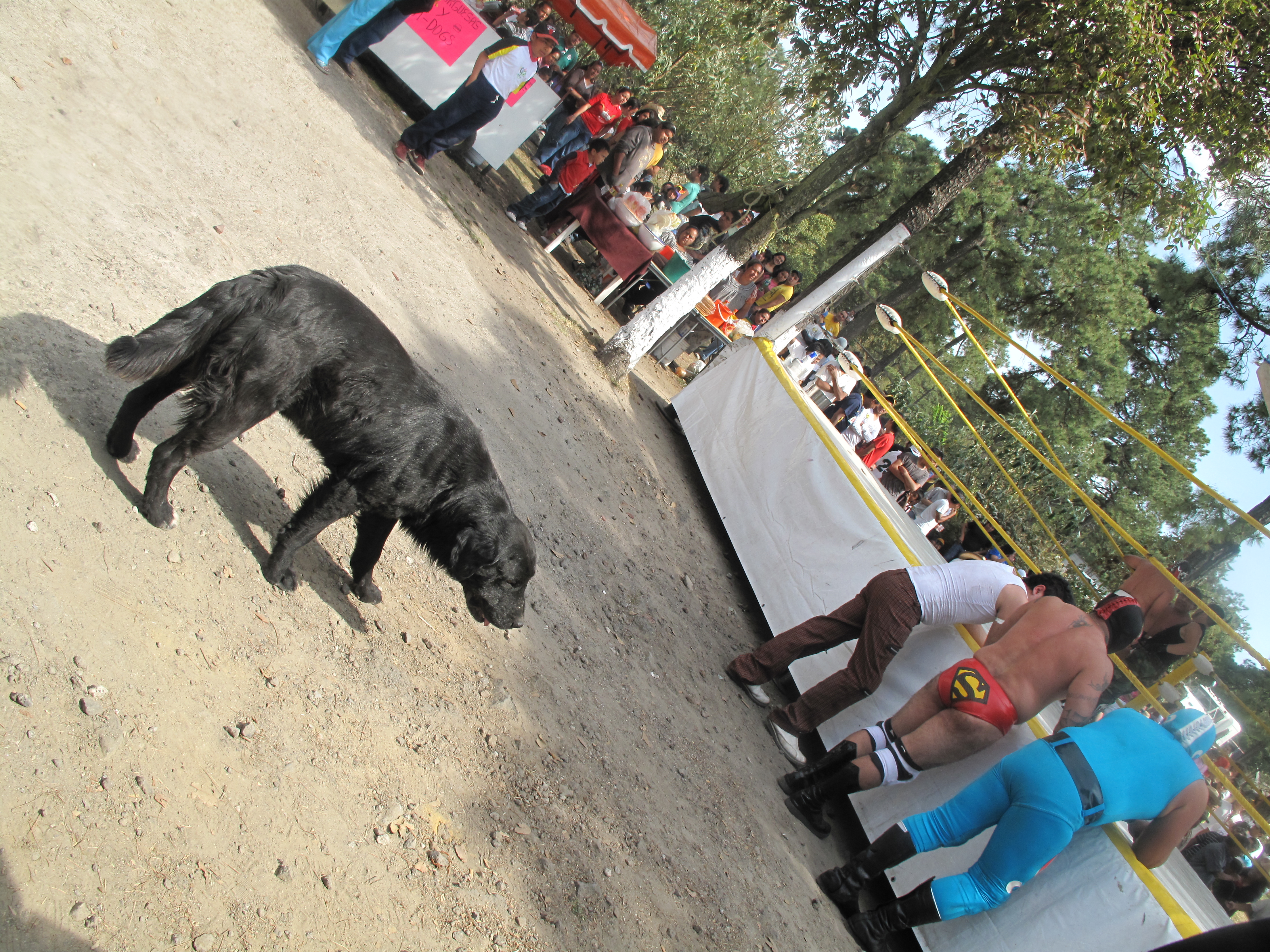
Wrestling the Maguey

A couple of wrestling matches, pulque and a gentle Sunday sun can make for a special cap-off to a weekend. Always down for an escape from the smog of the city,  we tripped up to the mountain in the south called Ajusco.

What led me on that journey was Niña Rap. I saw her the night before along with El Abogado and his Mano Armada Crew, and wanted to check them out again.  They were scheduled to perform at a mini music festival on the grounds of a pulqueria called La Frontera. It´s right across the Picacho-Ajusto freeway from the Gotcha compound.

Here´s  a slideshow of photos from the day I uploaded to Youtube.

Continue reading “Wrestling the Maguey”

Google Video pick of the week #005

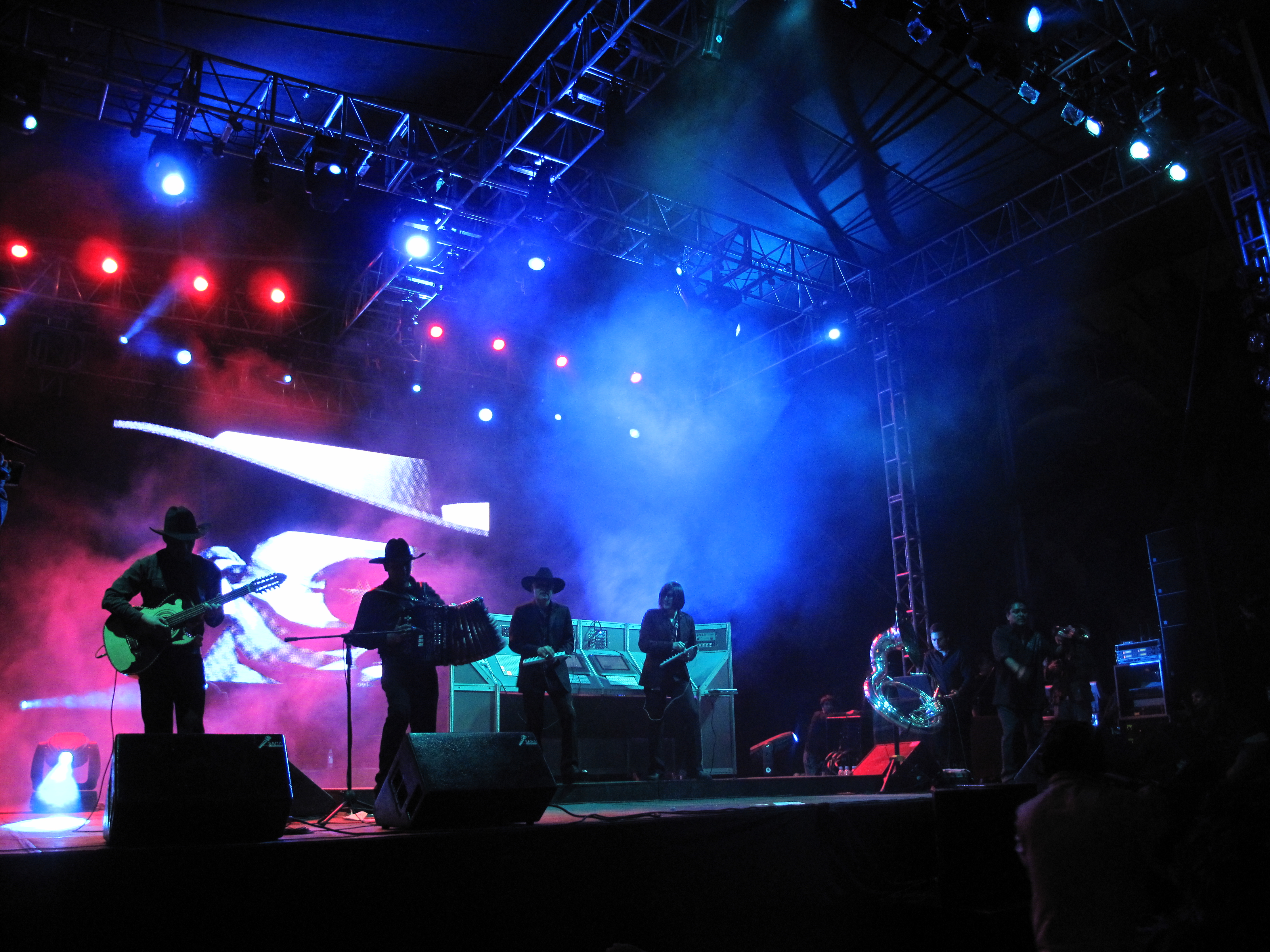
FMX Closing night featured Nortec Collective (March 28, 2010 Mexico City)

At one point during an unseasonably cold and windy Mexico City evening, the video monitors behind Nortec Collective showed some animation that resembled a Kraftwerk video, except the guys playing the machines had mustaches and Norteño style cowboy hats.

An appropriate nod to their forefathers in electro experimentation. Here´s video from Sunday night.

This week´s Google Video is a smart documentary all about how 3 young Black men channeled the cold, rust and depression of 90s Detroit into techno, Europe´s millenial music.  Of course, for me, techno used to only remind me of vampires in a club.