

Maluca was in town last week for a Mad Decent jump off.


In 2006, after reading online that Dr. Dre had a son recording tracks under the name Hood Surgeon, I got the hair brain idea I would find him and write about it for the L.A. Times.
It was an experience that gave me some good practice as a reporter. I tracked him down all the way to a home-built recording studio in Corona, CA. I also got a hold of his sister, Manaj, who was also trying to become a recording artist, charging that her bloodline to Dr. Dre gave her the right. Both were telling me that dad wouldn´t help them get on. Worst of all, after I did all the interviews and running around and writing, nobody wanted to touch my work, either.
A couple reporters at the paper tried to help me out. Zilch, nada. Nobody cared about Dre´s offspring. All they cared about was, ¨When is Detox coming out?¨
So, here I present to you gentle reader, in all of its unedited, 2006 glory my never-ran story on Dr. Dre´s two kids. Enjoy
¶ Inside the tiny recording booth, above a custom detail shop in the Inland Empire, a young man, at least 6’2, raps into a microphone. His back to the Plexiglas partition, he rhymes fiercely. Starting and stopping…assuring clarity in ever phrase.
“Stop. Go Back,” says the recording engineer, Rik Brown. “Hear the kick?”
It’s a process that takes longer to complete than one would imagine. How hard is it to rhyme into a microphone?
Using the moniker, “Hood Surgeon,” the rapper, born Curtis McClemore (he likes to tell people it´s young, but CA business records show otherwise), needs a deft hand to continue a legacy that has defined rap music in the West.
A fan of 90’s rap music, McClemore says he always was a fan of N.W.A’s music, but he also held admiration for East Coast rap. “I ain’t gonna lie, I grew up on Wu-Tang. I used to like how they put their lyrics together.”
“I thought the East Coast was the ones. Then when I found out,” he says referring to when his mother told him who his famous father was, “I was like, ‘the West,’ this is where it is.”
He said as he delved into the music characterized by the G-Funk sound made so famous by his father.
It was a zeitgeist for him, at 12, finding out he was Dr Dre’s first-born, “It pushed me harder. I said I was going to meet him one day.”
Long Road to meet his father
To the left of a flat panel computer screen showing Pro Tools rests a picture with a thin black frame. In it, Dr Dre stands next to a slightly taller version of himself, Curtis. It was at the “8-Mile” premier.
The picture shows a strange mix of nervous familiarity, and in some way resembles the kind of unfamiliarity a fan might share with his idol. It also exists on his myspace page. Further proof that he is who he claims to be.
Unlike his half-sister Latoya Young, who says that she’s always known who her father was, “Since I was 3.”
McClemore, who likes to say his last name is Young, didn’t meet Dr Dre until he hit legal drinking age.
“It’s like crazy growing up, not knowing who your real dad is, ” he says.
From his early 20’s, Dr Dre has documented his gritty upbringing on the streets of Compton. A founding member of seminal gangster-rap collective, N.W.A, Dre is often credited with creating the ever popular West Coast ‘G-Funk,’ a synth-heavy sound with a deep bass line that recalls the beauty and danger of California life.
McClemore, born in 1981, would have been born when Dre was 16.
Continue reading “Chasing the Hood Surgeon: On finding a son of Dr. Dre”

For all my family and friends on the East Coast enduring crazy weather this weekend, just remember, L.A. She keeps you safe and warm; like in California Dreamin´.
Click on the picture of the skyline and take a quick drive through downtown L.A. of the early 70s, in the opening minutes of Steven Spielberg´s Duel (1971), courtesy of Google Video.
|
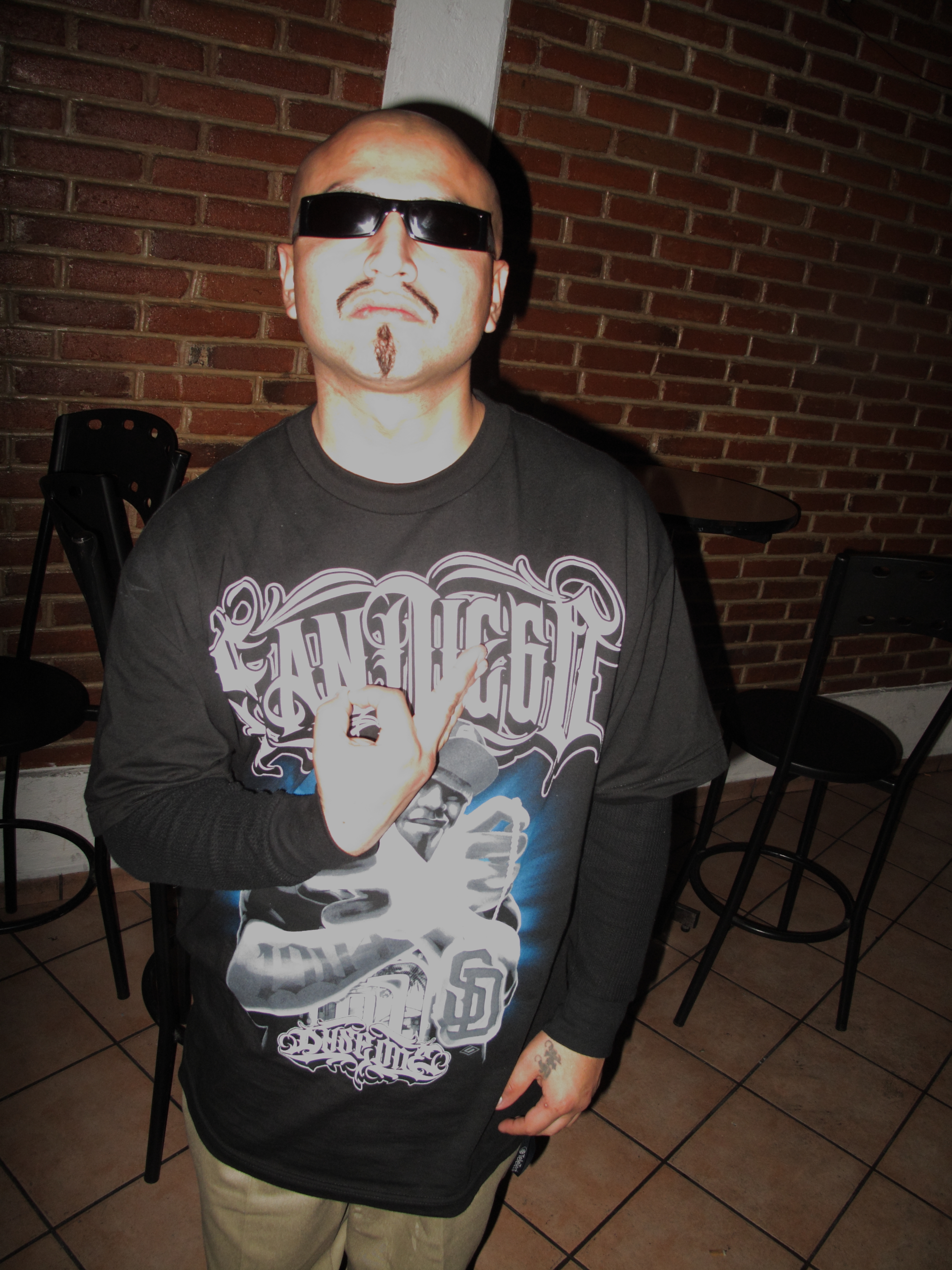
Lord Mzderio was deported to Mexico from San Diego last year. He wouldn’t elaborate on the reasons, but told me his aim, now that he was in D.F., was to make it big in the Mexican rap game.

The 20-something performer, who rhymes in Spanish, told me the only thing he found troubling about Mexico City, so far, was that his choices for cholo fashion leaned heavily toward L.A. It’s nearly impossible for him to find Padres stuff. Something gangster that didn’t rep that pinche city up north. He says he’s an S.D. gang member.
We had a quick chat after he performed in a virtually empty hall located at a goth club near El Centro Historico, on Puente de Alvarado in Col. Tabacaleraon, turning it into a rap showcase for Mexico City’s elite underground rappers. Those who had paid some dues.
Mzderio regaled me with tales of being locked up in the county jail, and how he was deported after he got out.
He had just arrived some months ago in the city, and was now living in Ecatepec, about 14 miles north of Mexico City.
What happened to Mzderio is possibly what happened to about 300 people in Texas on Friday.
According to the Dallas Morning News:
So, they say.

Large scale deportations like that are carried out by a branch of Homeland Security called, ICE. It was created in 2003 as a response to 911. Now, it’s part of a plan to rid the U.S. of as many people (“aliens” as they say) from Mexico and Central America, as well as other places, by 2012.
The Dallas piece went on to add:
These ICE tactics seem pretty flawed. The Washington Post goes on to say:
Describing ICE’s mission in 2008, the Newamericanmedia.org said:
Deportations doubled in the last 10 years according to this Medill report. The article goes on to point out that Mexicans are always the majority of the targets.
In Lord Mzderio’s case, whether for right or wrong, he’s here in Mexico now, and can share his passion for writing raps with another generation of Rap Kids, who need role models in a sea of Punks, skater kids, Chavs, Emos, Rockers, Fresas and Rastas.
Not the most aggressive entrance music.
Moby’s “Signs of Love” doesn’t make me think tough thoughts. El Hijo Del Santo has a legacy to live up to, he should really bring it with a little more aggression.
A charged crowed watched a scion of Mexican wrestling royalty one night, last month (A legacy of branding): El Hijo Del Santo. The son of El Santo, who fronted Sunday magazine, “Dia Siete” earlier this month. His series of holds or llaves, which they’re called in Spanish, look straight silly today; not that 50 years ago they looked any more real. It’s just nice to have that flavor, he uses moves his dad taught him probably. There was a family resemblance in that *camel clutch he used to win the match.
update: UK Sun talked to Hijo del Santo in 2008.
Is it true your father is buried in his mask?
Yes, it is true. When he died our first option was not to tell anybody and to keep it in the family but my brothers and I decided it wasn’t fair to keep him from his fans, so we decided to release the news nationwide. For the funeral, it was important for people to see him in his mask as they were not going to see Rodolfo Guzman, but El Santo, so yes, he was buried with his mask on.
*What a perfect camel clutch looks like.

Last year, The Atlantic´s Ta-Nehisi Coates gave a wonderful summation of why we need to recognize a Black History Month, and what´s wrong with the ways we´re brought up recognizing it. We reduce it to a bunch of pictures on class room walls and memorized passages. We need to look at our ancestors as humans not just as heroes.
As this February winds down, our first second Black History Month with a Black President, let´s not forget those who struggled before us. They would be proud of how much things have changed, and how many Black billionaires there are now.
Saul Williams and Trent Reznor, ¨Black History Month¨
|
|
XXX
Hip-hop isn´t as noticeable on the streets in Mexico City as it is in North America´s other major cities, NY, L.A., Atlanta, Toronto. That´s why this Rolling Stone (Mexico) billboard, above, caught me off-guard. You can find it throughout the city, on bus stops.
Does everybody know what Wayne represents, in the sense of representando? ¨A Milli¨ was played out a while ago. The only American rap cut I hear on Pop 40 Mexican radio is “Empire State of Mind.” Jay-Z is just mainstreaming himself like that I guess. That song Wayne did with Shakira, I hardly ever hear. It hurts my ears anyway.
The RS cover is a duplicate of the US version. Wayne going to jail, etc, etc. AP had a trite piece today on rappers going to jail
In the history of hip-hop, other popular rappers such as Slick Rick, Shakur, Lil’ Kim, Foxy Brown, Remy Ma, Beanie Sigel, Shyne, Mystikal and C-Murder have spent a few months to several years in prison. Snoop Dogg was acquitted of murder; Diddy faced jail time but he was acquitted in 2001 on bribery and weapons charges stemming from a club shooting. His protege, Shyne, wasn’t as lucky and was convicted in the same case and sentenced to 10 years; he was recently deported after his release from prison.
They talk to Shaka Zulu alot, Ludacris´manager and get the big jailhouse chat with Gucci.
Gucci Mane warns others to avoid his fate.
“Don’t keep bumping your head against the wall,” he says. “It’s a serious situation. It’s so many things that happen behind these walls. Think about how to avoid situations so you won’t have to come in here.”
The story is somewhat pointless, just a repeat trend piece some bored editor said to roll with, following RS´ lead this week.
The truth is, on the streets, going to jail is cred—a right of passage for Black/Latino men in America. Going to jail, as in the case of Tupac, and following that up with platinum success doesn´t happen to everyone.
I can´t name another rapper after, who had a publicized jail stint, then ran to the top of the sales charts when he became free again. What Wayne has working for him is that he´s still young. And, like Annette Funicello, Cubby or any Mouskateer, he´s been training for the music life since he was a pup.
But it´s not about that, going to jail for thuggery lends your rhymes credibility. I think if a rapper goes to jail for unpaid taxes or speeding tickets, it doesn´t work the same.
Of course, many of the faces referenced in the AP story bring the trouble on themselves.
Mainstream media and critics generally don´t have a clue when it comes to the particulars of these guys. It gets me.
Take for instance all the tatto-age on Wayne? Other than the ¨B¨ he´s holding up with his right hand, the rag in his back pocket and the ¨DAMU¨ scrawled on his chest—outright gang affiliation—what other reason does the ¨greatest rapper alive,¨ have to be going to jail? Thuggin(g), of course.

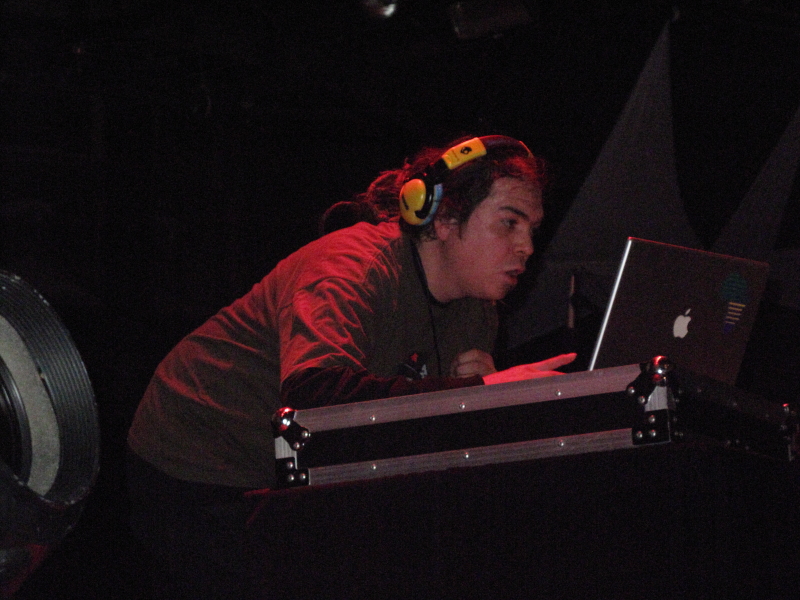
I first started hearing photos referred to as “flicks” sometime in the mid 1990s. Up to that point, a flick to me was a movie. One of the things a lot of guys and girls in my neighborhood would do is take a flick outside of a club against a spray-painted backdrop, usually a huge dollar sign or something else that signified urban cool. If it was a group of ladies, you would get the sexy pose; a group of guys and you would get the hard-rock pose with one guy kneeling in the front somewhere. Someone probably had a gold grille in the pic, too. The photographer was probably using a Polaroid camera and sold the picture for around $10 bucks. I know my boy Marcus has a ton stashed in a box somewhere.

Coming to the digital camera game late, I decided to bust more flicks myself. In the past year, I’ve upgraded to a Canon G10 and focused my eye on hundreds of things. If anyone peeps my Facebook albums, they know.

I just entered my first photo contest, and didn’t win, but one of my photos beat out a couple dozen others to get printed and displayed in the exhibit for The Space Farm, a media collective based in Mexico City, check them out, here. Then, if you’re in Jersey, go to Space Farms, just for the kitsch-y flavor.
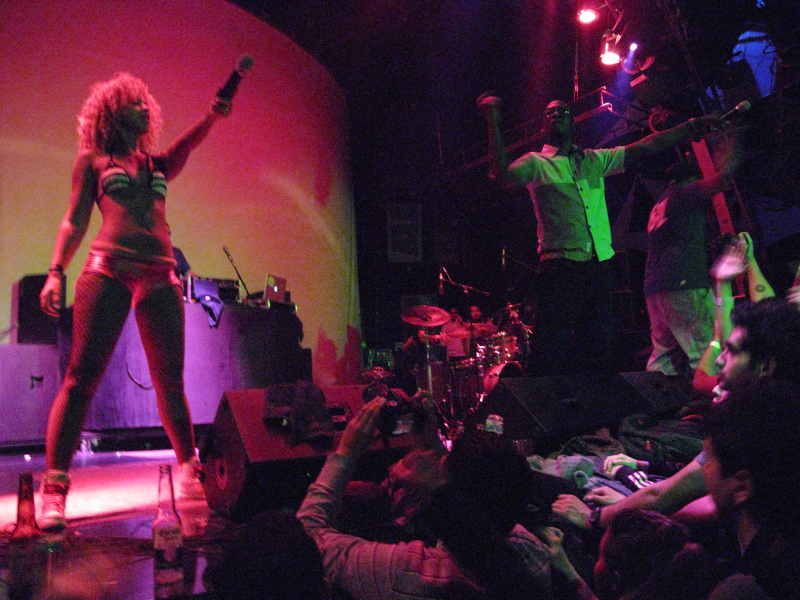
All flicks taken in Mexico City in 2009. They represent the four out of five I submitted that didn’t make the cut (from the top): Toy Selectah, Andrea Echeverri of Aterciopelados and Buraka Som Sistema.

The last time I spoke to my padrino was on the phone in the Summer of ’08. I remember him saying, “Just be careful,” regarding an article I had written on Charles Hamilton.
I asked, why? He repeated it: “Just be careful what you put out there about people.” I think he was referring to the heroin use I mention in the piece. I didn’t understand his point at the time, but as I thought about it I got it. A former Black Panther, he was about the people. And I was giving the establishment some good stuff on Charles. Although I don’t think that had anything to do with his fall off the map, or him getting socked.
Bob inspired me and dozens of other young men towards greatness. I’ll never forget that. From the time I was a little boy, until I reached adulthood he was there. A college professor and public servant, he leaves behind a large, beautiful family, with tons of friends and admirers. As one of the founders of the NY chapter of the BPP, he also leaves his mark on history.
You can read more about him in this quasi-controversial write-up in the Poughkeepsie Journal. You can also learn more about the Panther 21 trial, of which he was a part of, in Murray Kempton’s “The Briar Patch.” There’s an archived 1996 radio show that brought Bob on to talk about his past, here, with an appearance by Boots Riley from The Coup.
Now who’s going to give me bendición, eh?
Rest in Freedom, padrino.
Photo from Poughkeepsie Journal
update: Just googled the man a few more times and came up with this New York magazine article from 1972 that mentions Bob and offers some behind-the-scenes of the shenanigans that went on at his trial. Also, came across It’s About Time, a site that offers current info on Black Panther Party alum, reunions and personal histories of the group.
It hipped me to a documentary on Oakland Black Panther Party co-founder Richard Aoki, who passed away last year. He was a Japanese American revolutionary credited with bringing the first straps into the party.
To mark Black History Month, we’re celebrating Afro-Mexican History Month here at I Know Huh?.
In late October, I met Epifanía, a cigarette-smoking senior citizen in her 80s from the Costa Chica town of Cuajinicuilapa (“Cuaji”).

She came to Mexico City’s Museo Nacional de Antropologia, along with a larger group of elders and children invited to celebrate Dia de Muertos with a traditional danza de los diablos.
And just for good measure, here’s a 2005 piece talking about two documentary films focusing on Black Mexicans: “The Forgotten Roots” and “African Blood”.
Tony Gleaton’s photos were my introduction to Black Mexicans. No.
I’m wrong. It was Kemo.


 channibalsmith.com